Applying for Canadian Permanent Residency (PR) or preparing an active Express Entry profile is a life-changing milestone. However, the process comes with strict regulatory demands regarding background vetting and security clearances. If you have spent six consecutive months or longer in Canada after the age of 18, or if you receive a specific, mandatory request letter from Immigration, Refugees and Citizenship Canada (IRCC) during your application processing, you must submit an official set of fingerprints to the Royal Canadian Mounted Police (RCMP). Obtaining your RCMP Police Clearance Certificate (PCC) directly from India requires complete adherence to Canadian forensic standards and accredited digital submission pathways.
Because the RCMP does not accept direct fingerprint card submissions from individual applicants residing outside of Canada, you must utilize an authorized, certified workflow. Working with a highly experienced agency in India ensures your fingerprints are captured flawlessly on the official C-216C paper format and routed through an accredited Canadian CCRTIS server. This comprehensive guide provides an exhaustive, step-by-step roadmap to successfully securing your RCMP background check from India, avoiding costly technical rejections, and meeting your critical immigration deadlines on the first attempt.
What Is RCMP Fingerprinting and Who Needs It?
RCMP fingerprinting is the national criminal records search managed directly by the Canadian Real Time Identification Services (CCRTIS)—a division of the Royal Canadian Mounted Police. Unlike simple name-and-date-of-birth database checks, which can be inaccurate due to common names or variations in spelling, the fingerprint-based check searches for matching profiles within Canada's National Repository of Criminal Records. This repository compiles records of criminal convictions, active charges, and federal enforcement actions across all Canadian provinces and territories.
Need Fingerprinting Assistance?
Our certified mobile team captures professional prints securely. Avoid rejections with our expert service.
WhatsApp Us Now →For individuals residing in India, this biometric clearance is typically required for several key purposes:
- Canada Permanent Residency (PR) Applicants: Under Express Entry, Provincial Nominee Programs (PNP), and family class sponsorships, visa officers require a background check for any country where the applicant lived for 6 months or more consecutively. If you spent your college years or held a work permit in Canada, this is mandatory.
- Canadian Citizenship Requests: Applicants applying for Canadian citizenship who are currently in India and are flagged for secondary security review must submit fingerprints to confirm their eligibility.
- Federal Employment & Licensing: Professionals seeking employment with Canadian federal departments, or obtaining professional licensure (such as in healthcare, engineering, or legal services) from Canadian regulatory bodies while based in India.
- Work Permit & Study Permit Extensions: In specific cases where an applicant's historical record triggers a background questionnaire or dynamic request from IRCC.
RCMP PCC vs Local Indian Police Clearance — What's the Difference?
A very common point of confusion for Indian applicants is distinguishing between the Local Indian Police Clearance Certificate (PCC) and the Canadian RCMP check. The Local Indian PCC is issued by the Ministry of External Affairs through Passport Seva Kendras (PSK) or state police departments. It verifies your background and criminal history specifically within the boundaries of India. It has absolutely no bearing on your Canadian residency history.
Need Fingerprinting Assistance?
Our certified mobile team captures professional prints securely. Avoid rejections with our expert service.
WhatsApp Us Now →Conversely, the RCMP Certified Criminal Record Check verifies your legal conduct specifically during the months or years you resided within Canada. It does not check Indian databases. To apply for Canada PR from India, you must submit **both** certificates: the Indian PSK PCC to clear your history in India, and the RCMP PCC (along with any other countries you have resided in) to clear your international history. Both documents must meet strict IRCC checklist rules to prevent your application from being flagged as incomplete.
What Is an RCMP Accredited Fingerprinting Company?
The Royal Canadian Mounted Police maintains highly secure databases that connect only with verified, high-level portals. The CCRTIS does not accept physical fingerprint cards mailed directly to their processing facility in Ottawa from individual overseas applicants. They only accept secure, encrypted digital submissions transmitted by an official **RCMP Accredited Fingerprinting Company** located inside Canada.
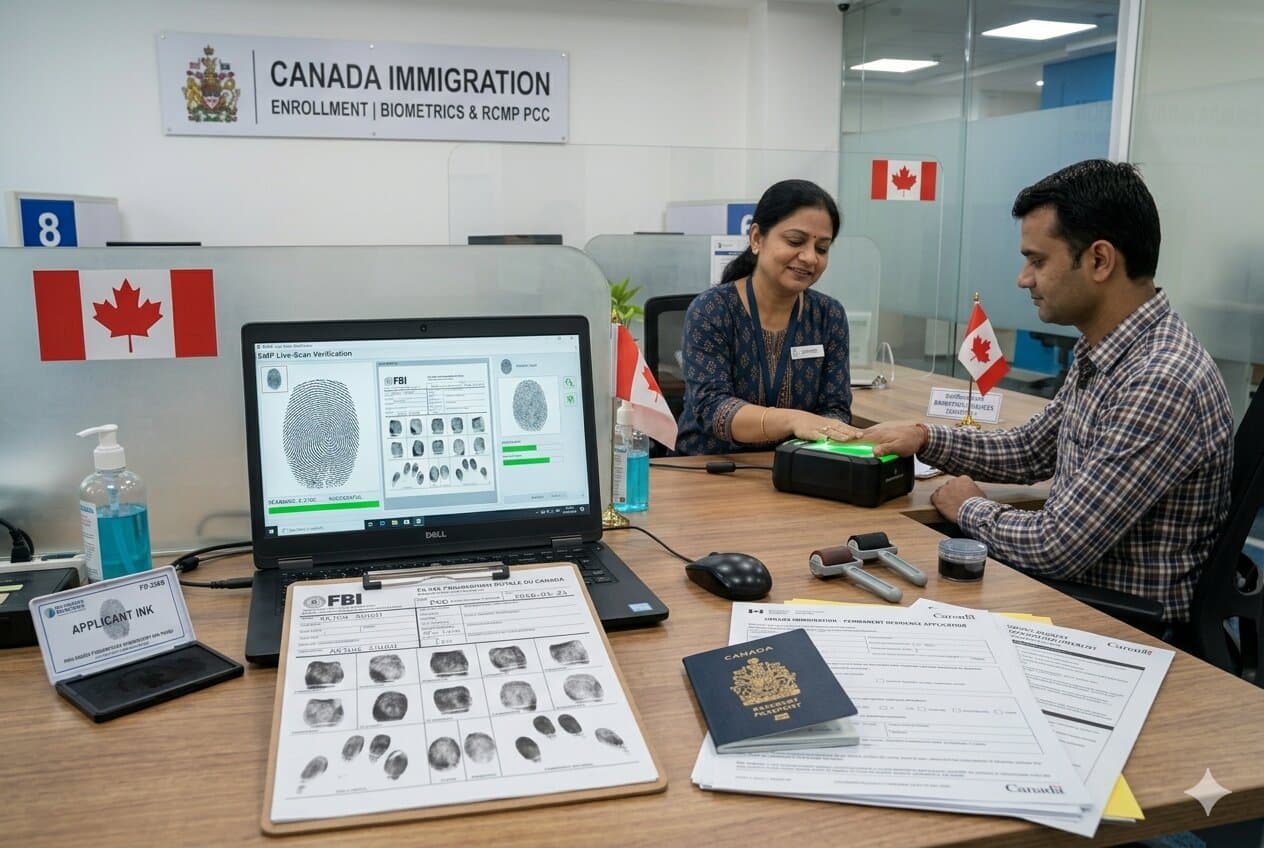
These accredited companies undergo rigorous vetting, security audits, and technical certification from the Canadian government. They act as secure technological bridges. When you are fingerprinting from India, a qualified domestic agency captures your physical prints on the Canadian C-216C paper form. This card is then shipped to the Canadian accredited partner, who utilizes specialized high-definition biometric scanners to convert the physical ink impressions into a secure digital file. This file is then uploaded directly to the RCMP's electronic servers, ensuring immediate ingestion and processing.
Need Fingerprinting Assistance?
Our certified mobile team captures professional prints securely. Avoid rejections with our expert service.
WhatsApp Us Now →The C-216C Form — What It Is and How It's Used
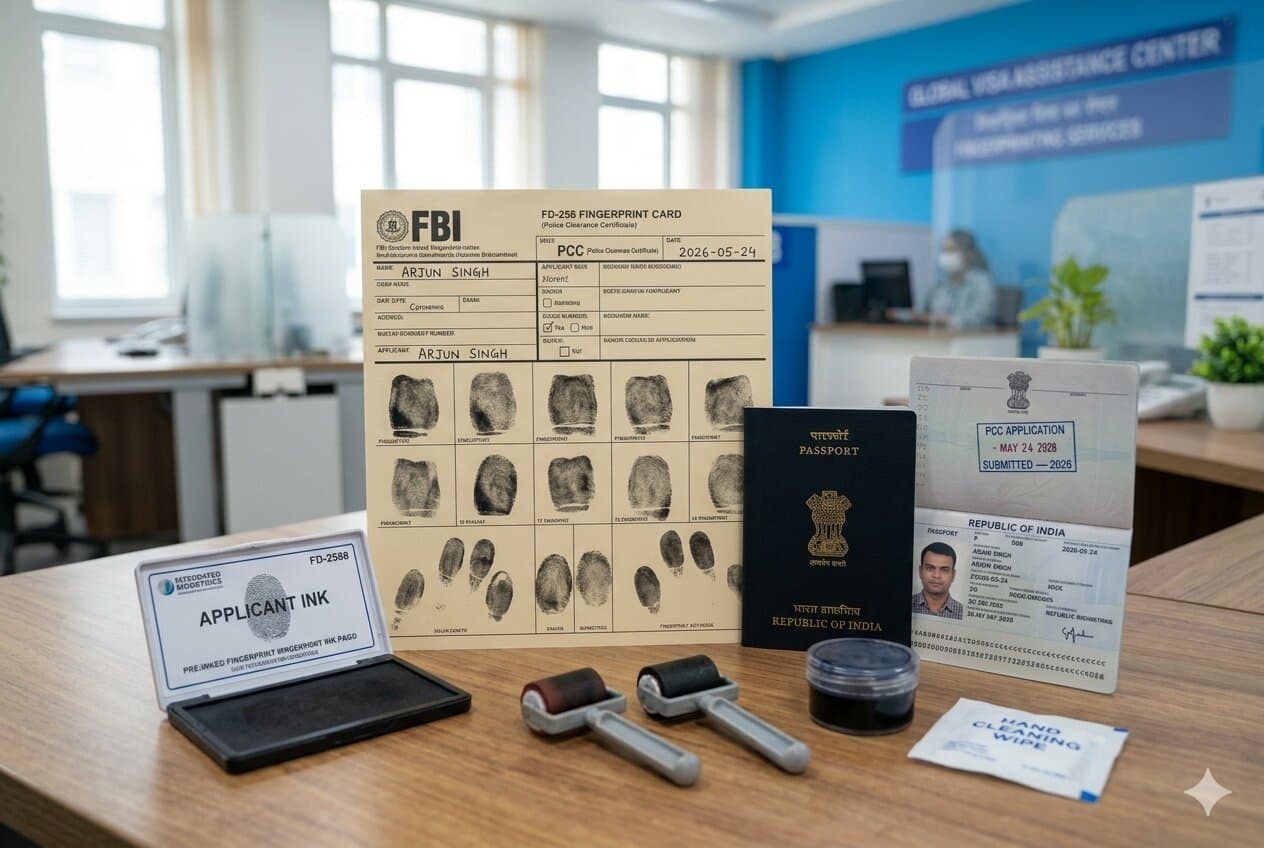
The C-216C form is the official physical fingerprint card standardized by the Royal Canadian Mounted Police. It contains dedicated, pre-formatted blocks designed specifically for high-contrast ink capturing. The C-216C card captures two distinct types of fingerprint impressions:
- Rolled Impressions: Captured in the upper ten boxes. The technician rolls each finger nail-to-nail to record the complete ridge pattern, showing all minutiae points needed for database matching.
- Flat or Plain Impressions: Captured in the lower blocks. These are taken by pressing all four fingers of each hand simultaneously, plus the thumbs. The flat prints serve as an anatomical reference to confirm that the rolled prints were placed in the correct sequential order and were not transposed.
Additionally, the C-216C card features biographical entry boxes that must be completed in black ink, including your full legal name, date of birth, gender, height (in centimeters), weight (in kilograms), eye color, hair color, and the signature of the applicant and the capturing technician. The card is printed on specific heavy cardstock to prevent deterioration.
Need Fingerprinting Assistance?
Our certified mobile team captures professional prints securely. Avoid rejections with our expert service.
WhatsApp Us Now →Step-by-Step: Getting Your RCMP PCC from India
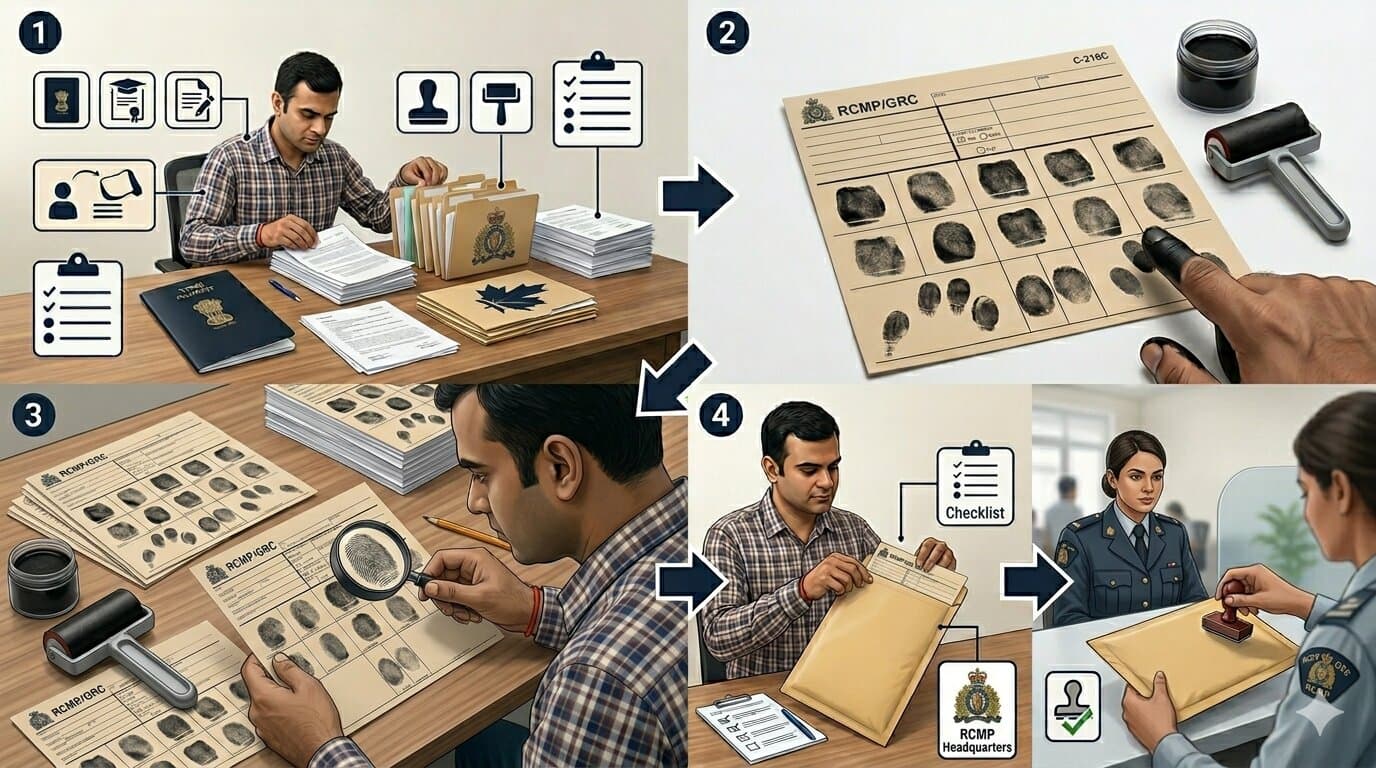
Step 1: Partner with a Certified Service Provider in India
Because the capturing must be flawless, working with a specialized agency like PCC Police Check is critical. We keep original, blank Canadian C-216C cards in stock and possess the specialized forensic-grade ink and roller assemblies needed for clean, smudge-free captures. Attempting to print the C-216C form on standard A4 paper will result in immediate rejection by Canadian scanners.
Step 2: Attend Your Fingerprint Capture Session
Need Fingerprinting Assistance?
Our certified mobile team captures professional prints securely. Avoid rejections with our expert service.
WhatsApp Us Now →Book an appointment at our Delhi NCR office or arrange for a mobile technician to visit your home or office in any major Indian city. The technician will verify your valid original Passport and second photo ID. Your fingers will be prepped, and the technician will meticulously capture your rolled and flat prints. We always capture at least two complete cards as a security backup.
Step 3: Forensic Verification & Quality Audit
Our senior forensic analysts review the captured cards under high magnification to confirm that the ridge detail is clear, there are no smudges or ink voids, and all biographic data fields match your passport spelling exactly. Once approved, the cards are securely packaged along with your ID copies.
Step 4: Secure Canadian Submission & Digitization
Need Fingerprinting Assistance?
Our certified mobile team captures professional prints securely. Avoid rejections with our expert service.
WhatsApp Us Now →We ship your physical C-216C cards via express international courier (DHL/FedEx) to our accredited partner company in Canada. Upon arrival, the cards are scanned on certified CCRTIS equipment. The scanned data is instantly digitized, encrypted, and uploaded directly to the RCMP's Ottawa servers for immediate processing.
How Long Does RCMP PCC Take From India? (2025 Timeline)
The total processing time is highly dependent on whether there is a matching criminal record in the Canadian national database. For clear applications (the vast majority of immigration applicants who have no criminal record in Canada), the timeline is exceptionally fast:
- RCMP Server Processing: Once the digitized prints are uploaded by our Canadian partner, the RCMP's electronic matching system processes and approves clear applications within about 2 to 3 weeks.
- Certificate Printing & Shipping: The RCMP prints the official Certified Criminal Record Check on secure, watermark security paper and mails it to our Canadian partner.
- International Transit to India: Our Canadian partner forwards the physical certificate to your address in India via secure, express international courier with tracking.
Need Fingerprinting Assistance?
Our certified mobile team captures professional prints securely. Avoid rejections with our expert service.
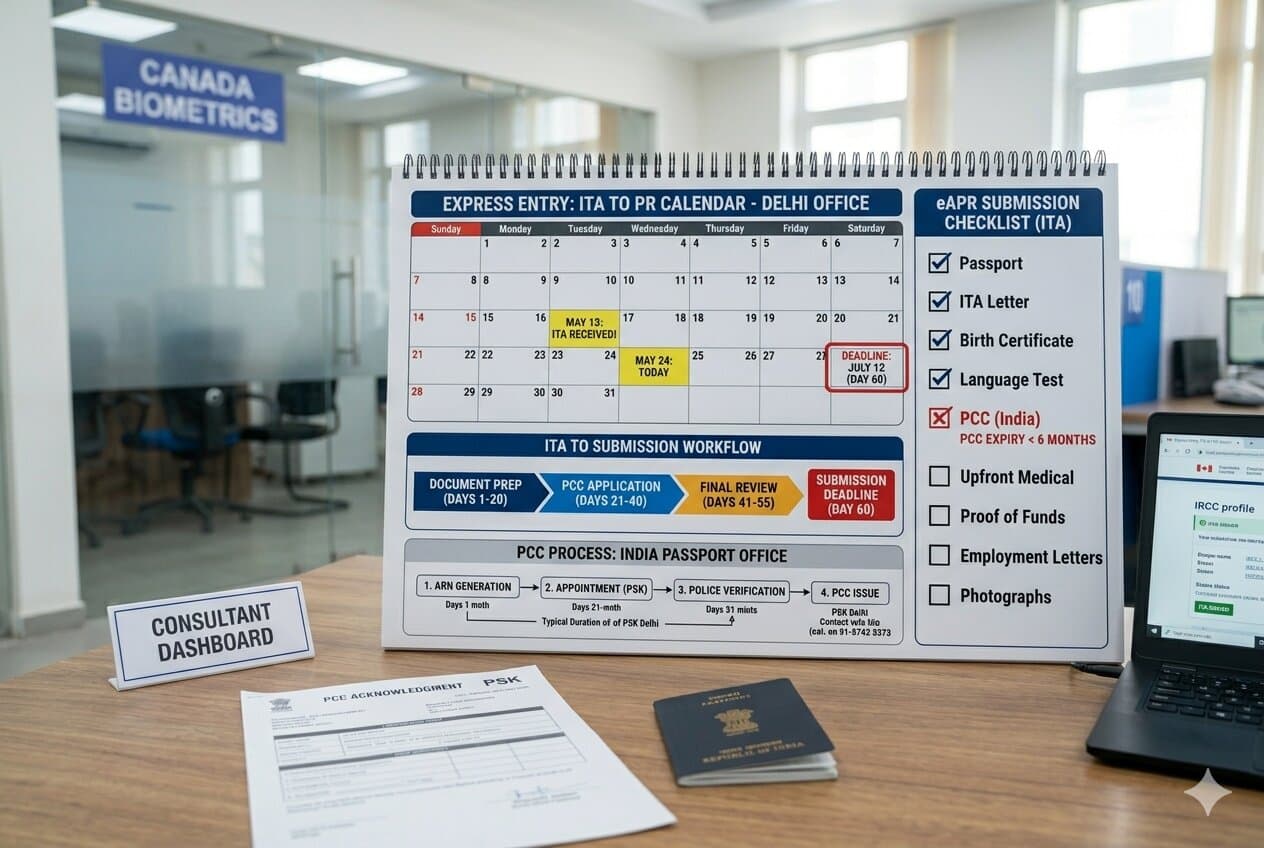
WhatsApp Us Now →In total, the entire end-to-end process—from your physical fingerprinting session in India to receiving the physical secure certificate at your doorstep—takes approximately **2 to 3 weeks**. We recommend planning this buffer to avoid Express Entry deadline anxiety.
Do RCMP Fingerprints Expire?
The Royal Canadian Mounted Police does not print an expiration date on their criminal record check certificates. The document represents a permanent historical record of your time in Canada. However, for immigration purposes, **IRCC maintains its own validity rules**. For Express Entry, a Police Clearance Certificate must have been issued within **6 months** prior to the final submission of your complete e-APR application. If your certificate is older than 6 months, you must undergo the fingerprinting and application process again.
Common RCMP Fingerprint Rejection Reasons and How to Avoid Them
Need Fingerprinting Assistance?
Our certified mobile team captures professional prints securely. Avoid rejections with our expert service.
WhatsApp Us Now →Rejection of your C-216C card by Canadian authorities will add several weeks to your timeline and can cause you to miss critical deadlines. Rejections are almost always due to avoidable technical errors:
- Incorrect Ink Application: Applying too much ink fills the delicate valleys between your skin ridges, resulting in a solid black smudge. Applying too little ink results in faint, broken lines. Both errors prevent digital scanner recognition.
- Incomplete Rolled Impressions: Failing to roll the finger fully from one edge of the nail to the other. The scanner checks the complete width of the print; partial captures are flagged as incomplete.
- Biographical Spelling Discrepancies: Any spelling mismatch between the name written on the C-216C card and your official passport biographic page.
- Using Non-Standard Paper: Printing the C-216C form on standard office paper instead of the official heavy cardstock, which creases and tears during shipping and scanning.
- Uncertified Capturing Channels: Relying on local notary publics, document typists, or general private detectives who are unfamiliar with Canada's strict CCRTIS forensic standards.